
A photograph can travel across the world without the person in it going anywhere. I can copy a JPEG from one computer to another, preserve exactly the same bytes, and reconstruct the same encoded image. Different screens may display it differently, but the file has not forgotten the face.
I am used to this. I work with images. Yet when I stop treating it as ordinary, it becomes strange again: an expression, a familiar pair of eyes, a moment that will never happen again, represented by data.
That thought leads me from photography to artificial intelligence, then to memory, DNA, and the picture of the world forming inside my own head. Somewhere along the way, a practical question about storing images becomes a much larger one: is information simply how we describe reality, or does it tell us something about what reality is?
The world inside a computer
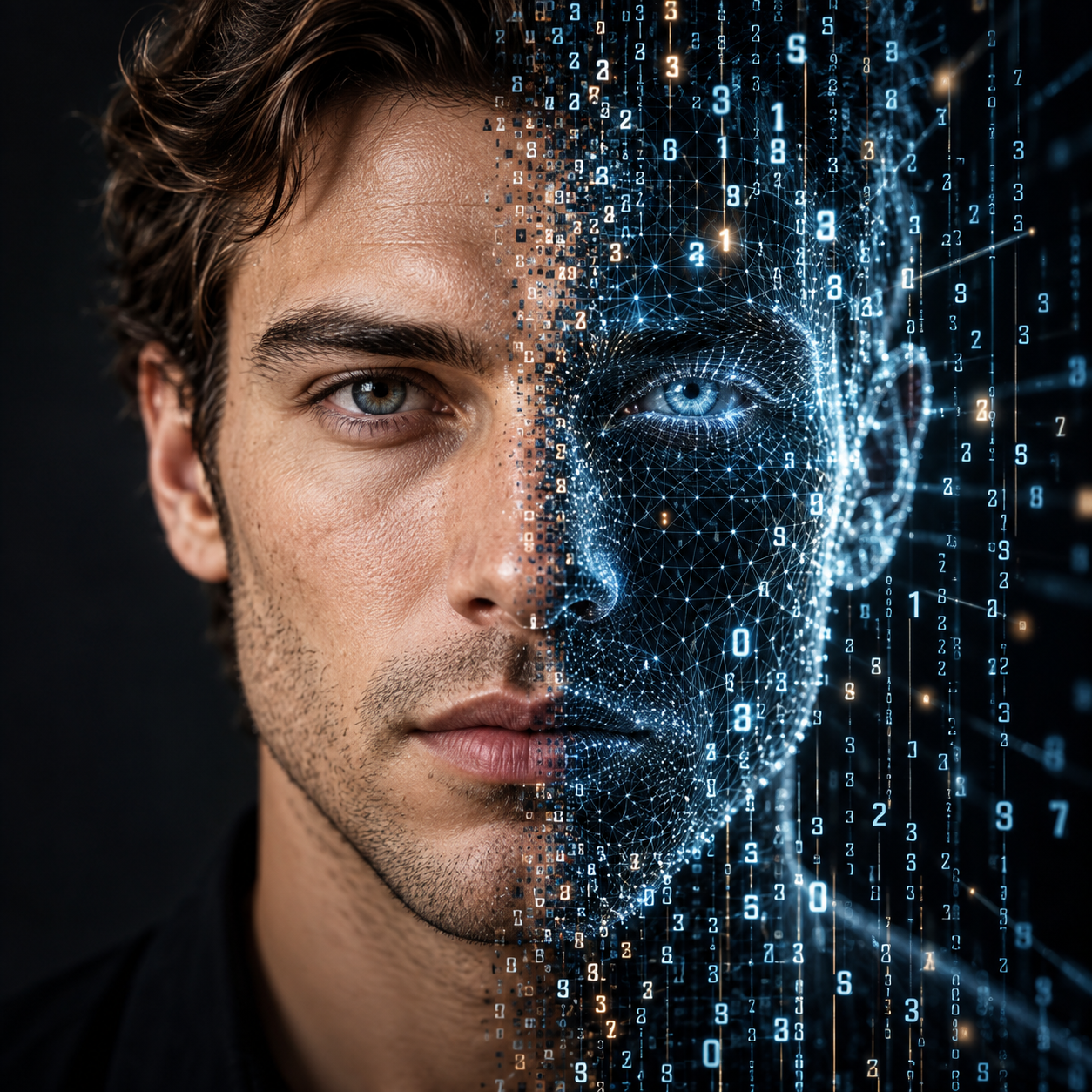
Inside a conventional digital computer, a photograph, a song, a movie, a game, and the instructions running the software are all encoded as bits. We can interpret those patterns numerically, although the meaning depends on the rules used to read them.
A JPEG is not usually a neat list containing one uncompressed number for every pixel. It is an encoded, typically compressed representation. Audio uses another representation; a game combines code, geometry, textures, sounds, and changing state. The shared point is that very different experiences can be reconstructed through numerical processing.
Copying the same JPEG does not progressively wear it out like making another photocopy. If the bytes remain identical, the stored information remains identical. Repeatedly editing and saving with lossy compression can change the image, but an exact file copy does not.
This makes me think about the distance between a thing and its representation. The file does not contain the person. It contains enough information for a particular image of that person to appear again. The difference seems obvious until the reconstructed face looks back at me.
When a face becomes numbers
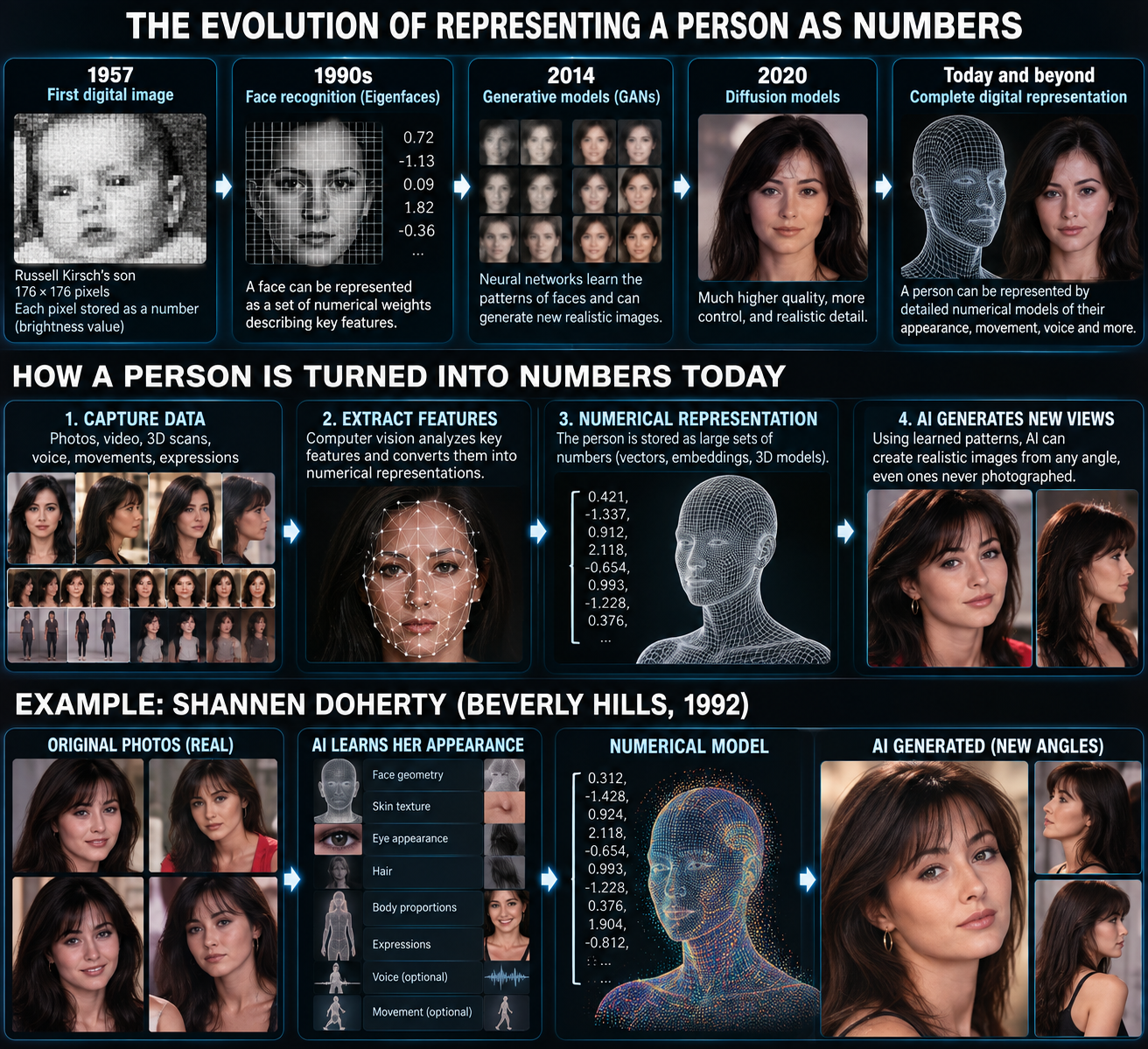
A digital camera measures incoming light through its sensor and processing pipeline. Those measurements become image data. A face that I recognize immediately is represented through values that, viewed without the appropriate decoder, would mean very little to me.
AI adds another layer. A generative model can learn relationships across many examples: how features tend to fit together, how lighting changes an appearance, how expressions alter a face. It can then produce a plausible face that need not correspond to any existing person.
I find the historical scale of this remarkable. In 1957, Russell Kirsch and his colleagues made a digital scan of his infant son’s photograph at just 176 by 176 pixels. NIST describes that image as an early foundation of digital imaging. Today, a synthetic portrait can carry enough detail to make me instinctively search it for personality.
But representing an appearance is not representing an entire human being. A face embedding, a 3D model, and a generated portrait serve different purposes. None automatically contains someone’s memories, consciousness, private history, or a perfectly recoverable identity.
What AI weights actually hold
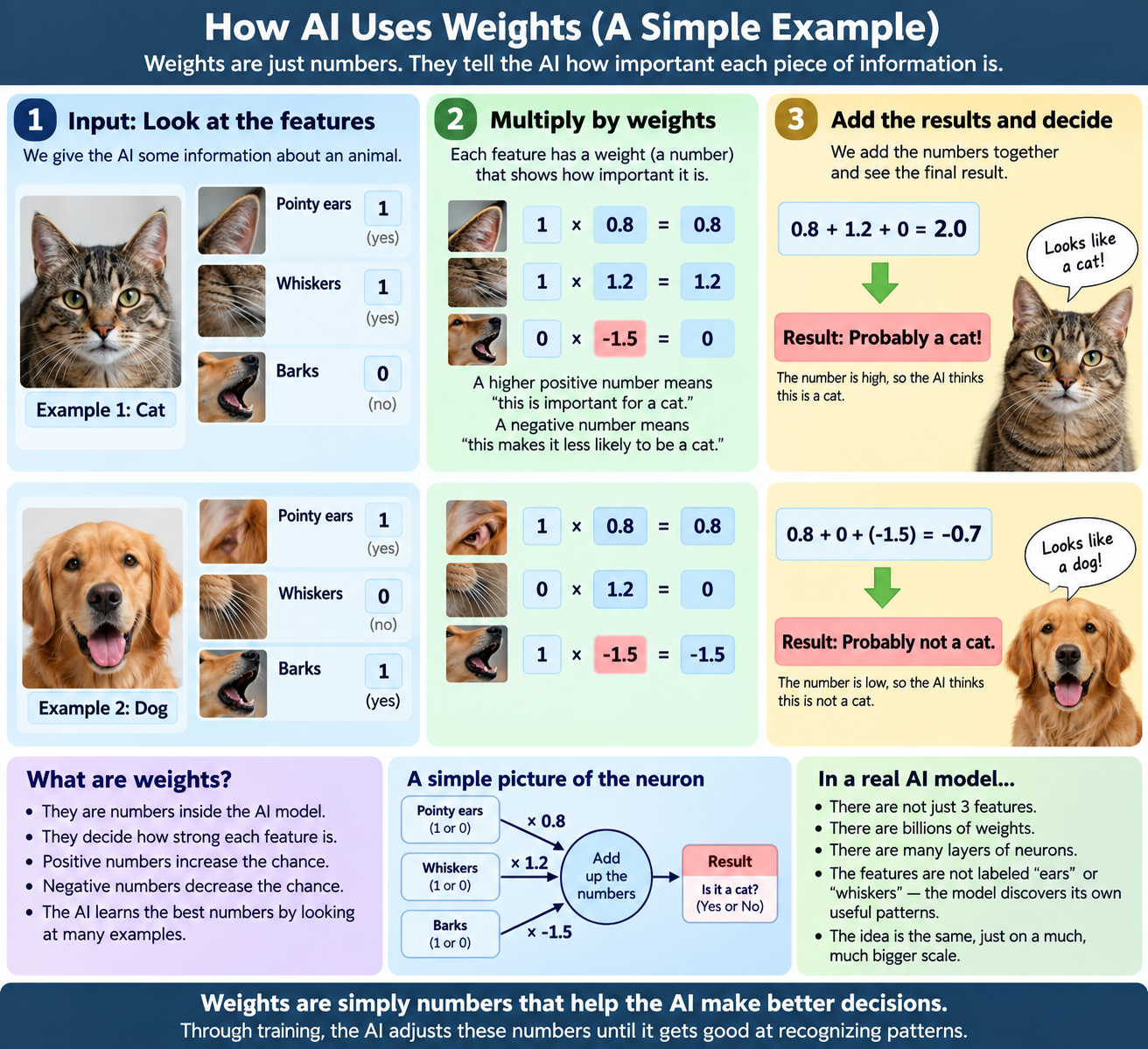
A modern neural network contains learned numerical parameters, including weights and biases. Training adjusts them so that the system performs better on its task. The architecture and the calculations matter too; a pile of numbers without the rules for using them would not be the same working model.
The simplest illustration is a score. Give several inputs different weights, multiply, and add. Some inputs push the score one way; others push it the other way. Real networks combine many calculations with nonlinear transformations, allowing them to model far more complicated relationships. Google’s neural-network explanation shows why those transformations matter.
I should not imagine a convenient drawer labeled “eyes,” another labeled “hair,” and a third containing complete photographs. Learned representations can be distributed across many parameters, and what an individual parameter does depends on the surrounding system.
Nor should I turn that into the opposite absolute: that models never memorize examples. Researchers have extracted near-copies of training images from diffusion models. Learning general patterns and retaining specific examples can coexist. The useful distinction is between a generative model and an ordinary archive where every source is deliberately stored as a separate, retrievable file.
The old film that still had more to show
Film makes this question more interesting because a film photograph does not begin as pixels or binary data. Light changes photosensitive material; development turns the exposure into an image that exists through physical and chemical structure.
I can imagine an old film production first transferred for DVD, later rescanned for HD, and later scanned again for 4K. The original object may reveal details that the earlier transfer failed to preserve. Kodak’s filmmaking reference guide explains how scanning resolution determines how densely the film is sampled.
There are limits. Film grain, focus, lenses, exposure, damage, and the scanner all affect what can actually be recovered. A larger output file does not guarantee more genuine detail. AI enhancement may invent plausible texture rather than uncover a record that was already there.
Still, I find something quietly unsettling in a physical object preserving more usable detail than an earlier technology could extract. The information did not appear because we bought a better scanner. Our access to it improved.
Could that happen elsewhere in nature? Almost certainly our measurements can improve; that much is familiar. Whether there are entirely unknown properties awaiting a new kind of instrument is a further question. I cannot infer a hidden world just because I can imagine one. But I can recognize that the limits of a measurement are not necessarily the limits of the thing measured.
My brain’s version of the world
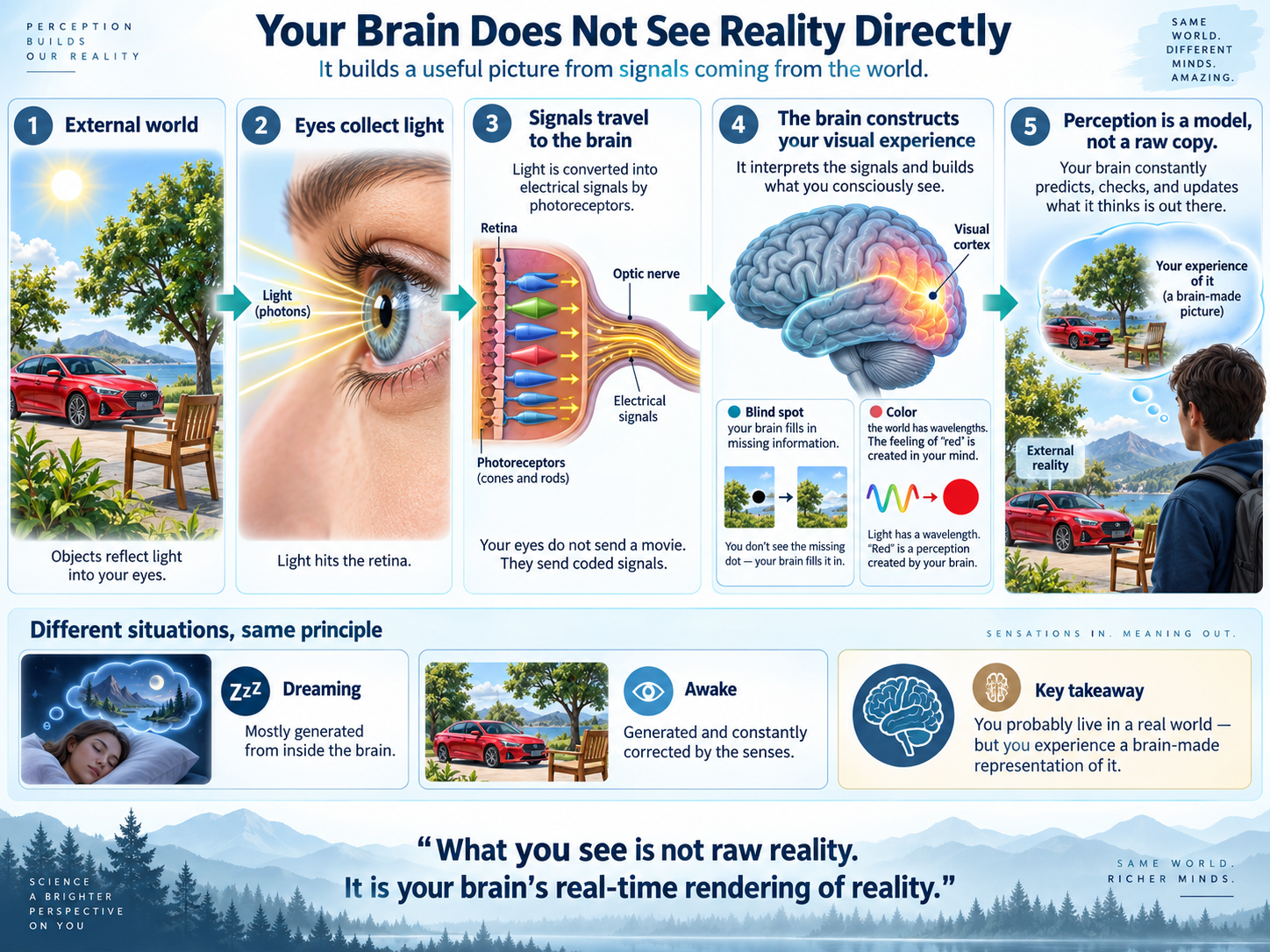
Then I turn the camera around, toward myself. When I look at a tree, my eyes do not deliver a miniature movie to a spectator sitting inside my head. Photoreceptors convert light into signals, and neural systems process them. The National Eye Institute describes the path from retina to brain.
My experience of color, depth, motion, and recognizable objects emerges through that processing. The brain combines incoming evidence with context and experience; perception is an active construction, as the NEI’s Visual Circuits Section explains. “Construction” does not mean arbitrary invention. The external world continually constrains and corrects what I perceive.
Dreams make the generative side harder to ignore. A brain can produce scenes, faces, places, and a feeling of presence without a matching scene entering through the eyes. NINDS notes that dreams occur across sleep stages, with especially vivid dreams often associated with REM sleep.
That makes “biological rendering” an appealing metaphor for conscious experience. It is a metaphor, though, not evidence that the brain literally runs a graphics engine. There is no need to imagine an inner screen or another person watching it.
Perhaps what I experience is something like an interface: useful access to an underlying world, shaped by the kind of organism I am. That possibility does not prove the world is unreal. It reminds me that experiencing something and accessing it without mediation are different claims.
The television show I cannot replay
I watched television shows decades ago. I cannot close my eyes and replay every frame, every line, every camera movement. Much of what remains feels less like a recording and more like a web: faces, places, feelings, fragments, relationships.
Then a theme tune starts, or an old photograph appears, and something returns that I had not consciously thought about for years. A name brings back a room. A face brings back the atmosphere of a particular period of my life. I wonder how much was still accessible and how much my present mind is reconstructing.
I cannot assume that vividness proves accuracy. Remembering a scene confidently is not the same as checking the original recording. My memory gives me a way to revisit experience, but it does not promise an intact archive of everything I saw.
I see a cautious parallel with AI here: both prompt questions about what remains after exposure to many examples, and how a cue can bring a pattern forward. But their mechanisms differ, and the comparison does not establish that AI has human recollection or subjective experience.
In AI products, “memory” can also mean several separate things: training parameters, the current conversation, saved notes, or an external database. Those should not be collapsed into a single mysterious ability. What interests me is the narrower question: how can an experience leave an influence without surviving as an easily replayable file?
DNA: information that helps build a body
A tiny biological sample can contain cells carrying DNA whose sequence contributed to the development of an entire human body. That is extraordinary even before I add any philosophy. The NHGRI’s DNA fact sheet describes how biological instructions are encoded in DNA and used by cells.
Genetic variation can influence pigmentation and many other physical traits. But DNA is not a hidden JPEG of a finished person. I think of it as part of a biological construction system: sequences, cellular machinery, regulation, and interactions with the environment, operating through development.
The distinction matters. A person’s appearance also reflects age, life history, nutrition, surroundings, and chance. Knowing a genome would not give me a perfect photograph of that person at every moment of life. Identical twins alone make the idea of DNA as a complete life recording difficult to sustain.
I am also careful with the word “instructions.” It does not imply a programmer or conscious intention. It describes how molecular sequences participate in biological processes. The physical interactions do the work.
Yet the comparison with photography stays with me. A photograph preserves a particular view. DNA participates in producing living structures. Both involve physical arrangements carrying information, but they carry very different kinds.
The ancestors still present in fragments
Every person arrives through an enormous chain of previous generations. Genetic inheritance connects me to that history through actual biological material, not simply through names written on a family tree.
Most nuclear DNA is reshuffled across generations. During the formation of eggs and sperm, paired chromosomes can exchange segments through recombination. What reaches me is a changing mosaic, rather than a complete preserved copy of each ancestor.
Mitochondrial DNA is normally inherited through the maternal line. Y-DNA can help trace a direct paternal line in people who carry a Y chromosome. These are particular routes through a family tree; neither represents all of someone’s ancestry.
Autosomal ancestry analysis compares variants across a broader part of the genome. Its conclusions depend on reference samples and statistical methods. Ancient population relationships can leave detectable traces, but those traces are not portraits, names, or a full account of individual lives.
Some genealogical ancestors may leave no identifiable autosomal segment in a particular descendant. So I cannot assume that sufficiently advanced technology will reconstruct every ancestor from my DNA. A better reader cannot recover a record that was never retained.
Still, future research may improve how we interpret genetic sequences and other biological signals. How much biologically meaningful information are we currently overlooking? I can ask that without claiming our bodies contain ancestral movies or inherited personal memories. The uncertainty is interesting enough on its own.
Computing beyond the familiar chip
Once I stop equating information with a file on a laptop, other forms of computing become easier to imagine. Digital silicon electronics are extraordinarily successful, but they are not the only physical way to process information.
Analog computing uses continuously varying quantities, such as voltages or mechanical positions, to represent a problem. Chemical computing investigates reactions and molecular states as processing systems. Biological computing can use engineered cells or biological components; DNA computing uses designed strands and molecular operations.
This is more than a futuristic image. In a 1994 experiment, Leonard Adleman used DNA and laboratory operations to solve a small instance of a mathematical path problem. That did not produce a general-purpose computer in a test tube, but it demonstrated a different physical route to computation.
Neuromorphic research explores brain-inspired hardware and algorithms, often using spikes and event-driven processing. Such systems can still be silicon-based. Brain-inspired does not automatically mean biological, conscious, or a complete replica of a brain.
Our own brains already operate through electrochemical activity in living tissue. I do not know what future artificial intelligence will run on. Perhaps conventional chips, perhaps hybrid systems, perhaps something much less familiar. None escapes physical limits, and an alternative material does not automatically make a better intelligence.
Generating a possibility is not discovering a fact
I see the same boundary in engineering. AI could help explore engine geometries, control strategies, or cooling arrangements, while simulations narrow a huge design space. But a beautiful diagram and a confident prediction do not establish horsepower, efficiency, or durability.
A physical prototype has to survive physical testing. A model can omit something crucial. A generated detail can look convincing while being wrong. The distinction applies equally to a reconstructed face, an enhanced film frame, an ancestry estimate, and an ambitious explanation of the universe.
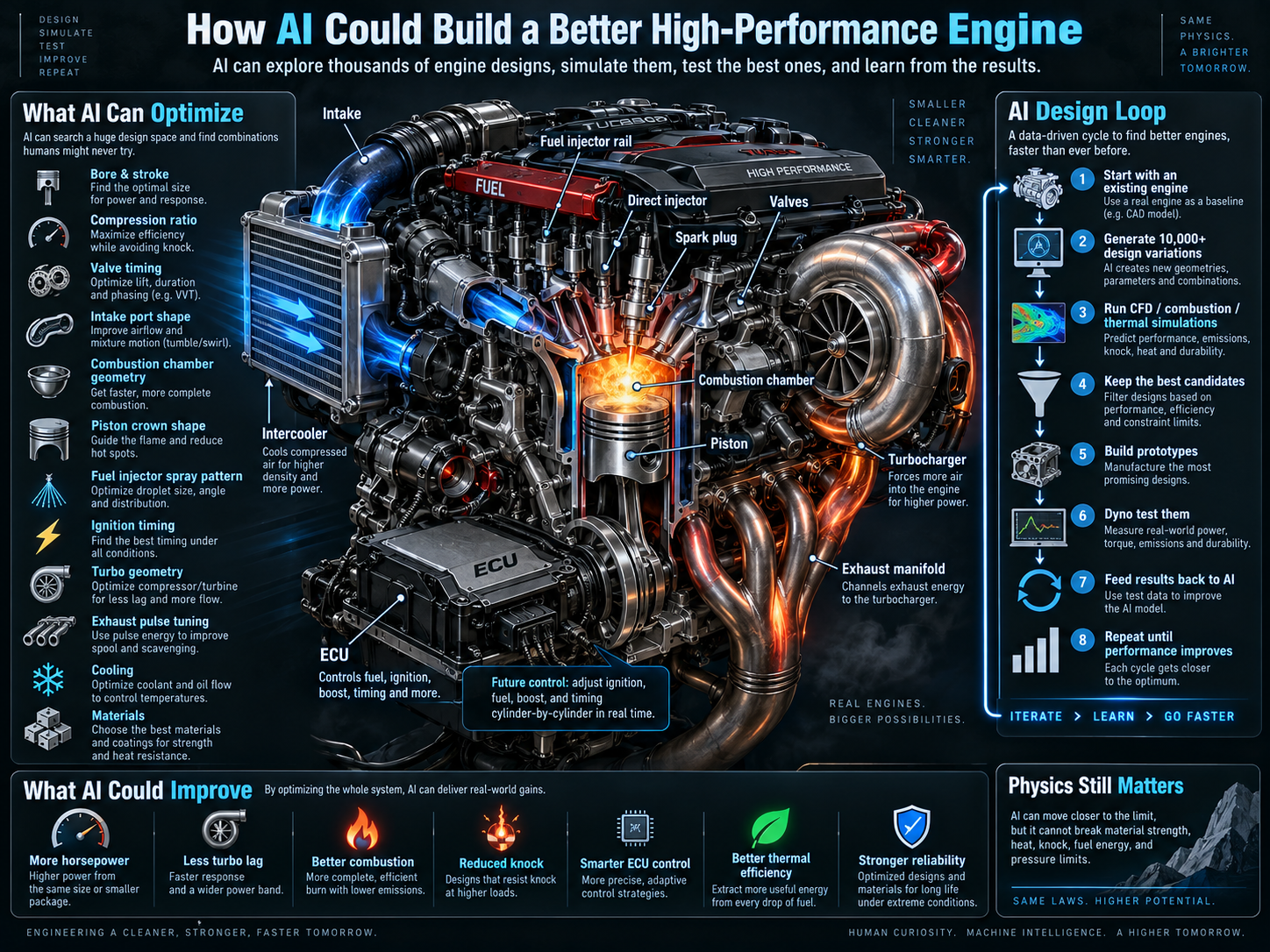
That is why I want evidence beside imagination. It does not make the questions smaller. It gives me a way to tell when a possibility has begun to become knowledge.
Is reality itself information?
Photography shows me that an encounter with the world can leave a reconstructable record. Film shows me that the record can be physical before anyone digitizes it. DNA shows me that molecular arrangements can carry biological information across generations. AI shows me that learned relationships can produce new outputs. My brain shows me that even the world I experience reaches me through processed signals.
These are connected observations, but they are not interchangeable. I should not slide between information as stored data, information as reduced uncertainty, and information as meaningful instructions, then pretend I have proved one grand conclusion.
Nor does describing reality with numbers establish that reality is made of numbers. A mathematical description of a flame does not burn paper. A simulation of a storm does not make the computer wet. A representation can preserve important relationships without being the thing represented.
Perhaps mathematical and informational descriptions reach unusually deep into the structure of nature. Perhaps they are powerful tools shaped by how minds like ours organize observations. Perhaps the distinction needs concepts we have not developed yet. None of these possibilities makes simulation theory an established scientific result.
I explored a related problem in my earlier thoughts about AI and the limits of reality: greater intelligence cannot simply substitute for missing evidence. The same restraint belongs here. Wondering what lies beneath our descriptions does not give me access to it.
What stays with me is the continuity: light leaving a face, chemistry preserving a moment, a sequence crossing generations, a pattern surviving in memory, numbers producing an image. I do not see proof of a hidden computer behind the universe. I see familiar things becoming unfamiliar when I look at how they carry traces of something else.
Are numbers merely a language we invented to describe reality, or are we slowly discovering that information is one of the fundamental ingredients of reality itself?