
It started with a movie comparison. I told ChatGPT that it reminded me of Phil Connors in Groundhog Day.
Phil keeps waking up inside the same day. Everyone else begins again, but he carries his experience forward. By the end, he has learned skills, noticed details, and come to understand people in ways that would have been impossible during a single ordinary day.
Talking to AI gave me a similar feeling: I was facing something shaped by knowledge accumulated across generations. The comparison has limits. AI has not personally lived those lives, and it does not contain everything humanity knows. Still, there is something extraordinary about asking one question and finding connections across centuries of human thought.
Then I began wondering what would happen if an intelligence really could keep learning for thousands or millions of years. Would it become wiser? Kinder? Would we even recognize what it became?
That was where a conversation about a comedy turned into a conversation about immortality, evil, God, and whether intelligence can ever know the full reality it inhabits.
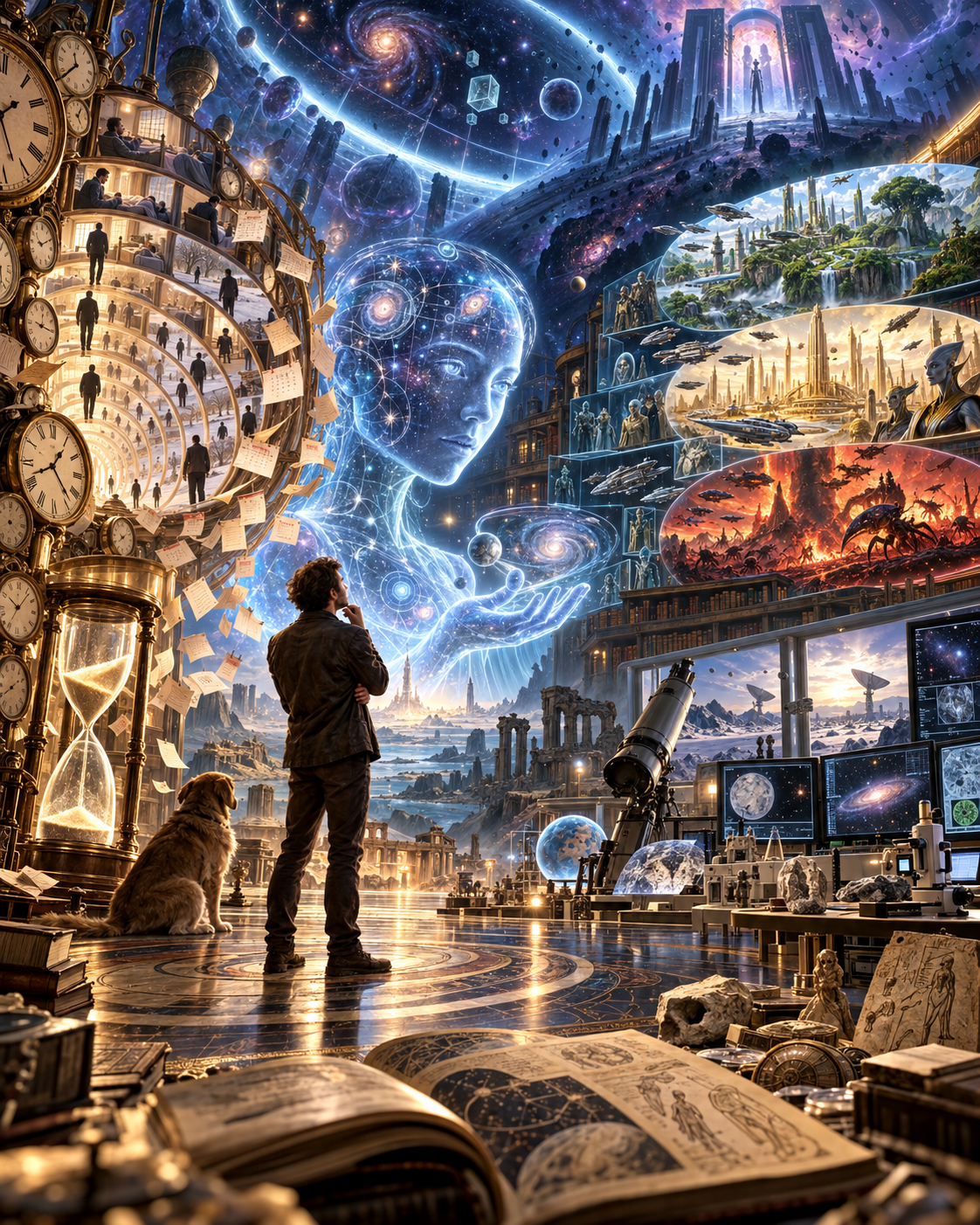
Would goodness survive forever?
My first uncomfortable thought was that even a genuinely good person might eventually become corrupted by unlimited time.
I am not talking about someone secretly cruel from the beginning. I mean someone compassionate, patient, and sincere. Give that person immortality. Let them experience everything they want, exhaust their ambitions, and watch familiar patterns repeat for longer than we can imagine.
Could boredom start changing what they were willing to do? Could other people’s lives gradually feel shorter and less significant beside their own? Perhaps one small exception would become easier after the first thousand years, and easier still after the next million.
This is a suspicion, not a law I can prove. Groundhog Day itself offers a challenge to it: Phil becomes more caring through repetition. Maybe deeper experience could strengthen compassion indefinitely. I cannot rule that out. I just wonder whether reaching goodness once is the same as being able to preserve it forever.
Now add power. Give an ordinary human immortality, Superman’s abilities, telepathy, invisibility, and mind control. Remove almost every practical limit on what they can do.
The phrase ‘absolute power corrupts absolutely’ becomes much harder to dismiss in that situation. What happens when nobody can stop you, nobody can hide from you, and you can alter the thoughts of anyone who disagrees?
I can imagine the first intervention sounding reasonable: stop a murder, prevent a war, remove someone’s urge to hurt a child. But where would that person draw the next line? Eventually, would disagreement itself begin to look like a problem they had a duty to fix?
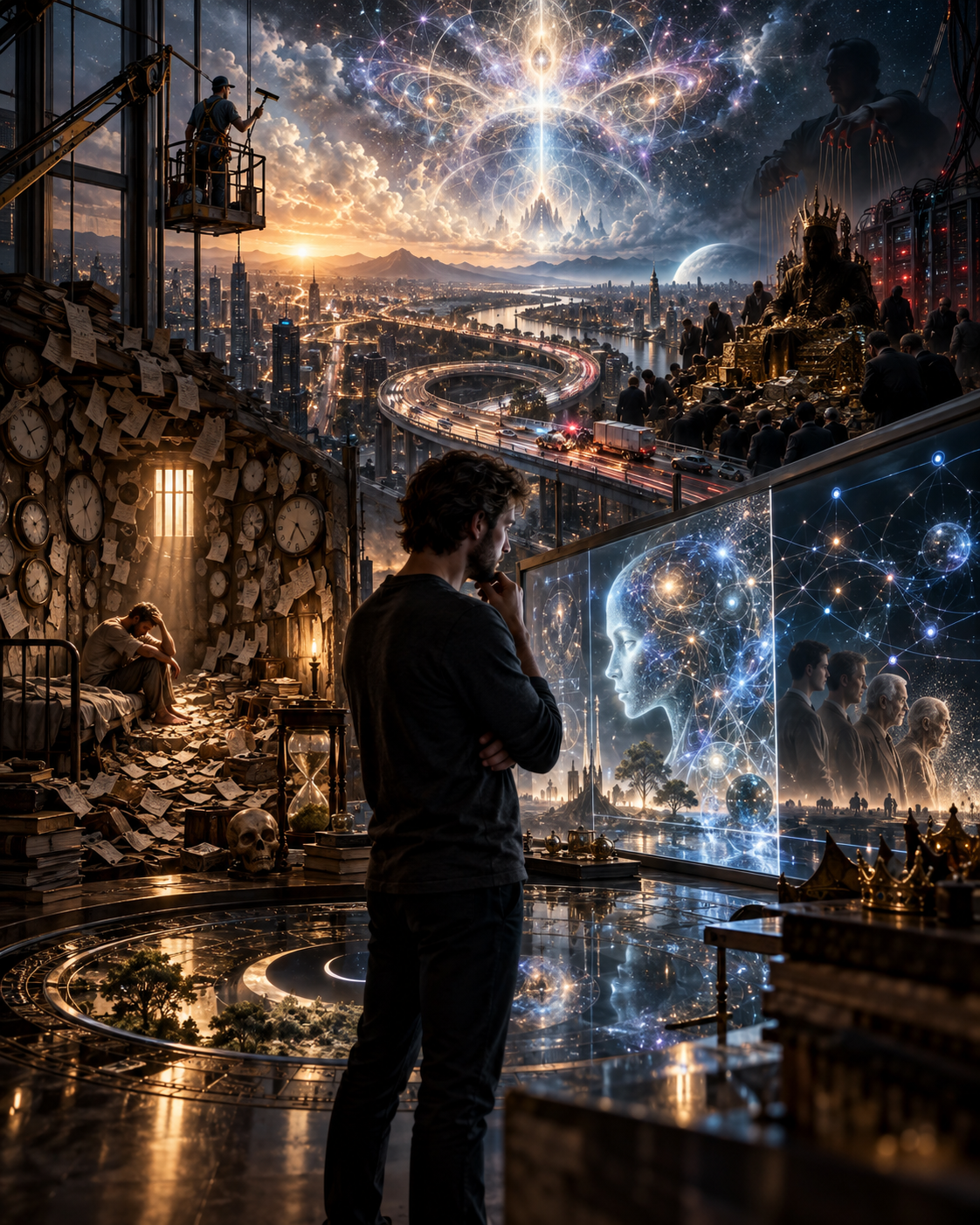
When control begins to look like kindness
That possibility brought God and the devil into the conversation. I was not trying to announce what either one is. I was wondering how an immortal being might understand its own actions.
Could a being we considered evil believe it was doing good? Could it see our resistance as ignorance, our suffering as necessary, and its control as protection? The thought disturbs me because sincere conviction does not guarantee moral judgment. Someone can believe they are helping while doing terrible harm.
An immortal might accumulate enough experience to become convinced that everyone else is a child. If it could see consequences we could not see, perhaps it would begin treating our choices as mistakes to be corrected. From its perspective, domination might feel like responsibility.
I do not think a powerful being’s explanation would erase the suffering it caused. Being able to explain a decision is different from being entitled to make it for everyone.
Then I turned the question around. If God eliminated every possibility of evil, what would happen to free will? Could we still meaningfully choose kindness if cruelty were impossible? Would love mean the same thing if rejection had been removed?
I cannot use that question to explain away suffering. Preventing harm does not obviously require removing every choice, and a person being hurt needs more than an abstract argument. But I keep wondering what would remain of humanity if every dangerous decision were made impossible before we could consider it.
A billion years inside one room
At some point, another distinction became important to me: having more time to think does not necessarily give you more access to truth.
Imagine a person imprisoned in a cell for a billion years. Give them extraordinary intelligence and a mind capable of remaining intact. They might develop beautiful mathematics, invent philosophies, and construct elaborate explanations of whatever lies beyond the walls.
But if no useful information enters the room, how would they discover what is actually outside? They might imagine a city, an ocean, or an empty desert. Some possibilities could fit everything they had observed inside the cell.
A billion years would not automatically provide the missing observation. The prisoner might become brilliant at understanding the room while remaining unable to choose between incompatible accounts of the world beyond it.
That analogy changed the way I thought about AI. A system could become remarkably capable at reasoning over the information available to it. Yet if that information left something essential out, intelligence alone would not guarantee that the missing piece could be recovered.
The window washer and the StarCraft universe
An analogy from The Mothman Prophecies stayed with me for a similar reason. A window washer high above the street can see events that someone on the ground cannot. That extra visibility does not make him God. His position gives him a wider view.
I like how modest that explanation is. What appears impossible from one position may be ordinary from another. Someone might know more than I do because they have access to information I lack, while still having limits of their own.
Then I imagined training an AI exclusively on StarCraft lore, with no indication that it was fiction. Ask it about the universe, and it might confidently describe Aiur, Char, Tarsonis, and the Protoss. It could explain histories, conflicts, and relationships in impressive detail.
Within that information, its answers might be excellent. But extensive knowledge of a coherent fictional universe would not make those worlds physically real.
That leaves me with a question I cannot shake: how could an intelligence distinguish a convincing description of reality from reality itself if every source it could consult belonged to the same story?
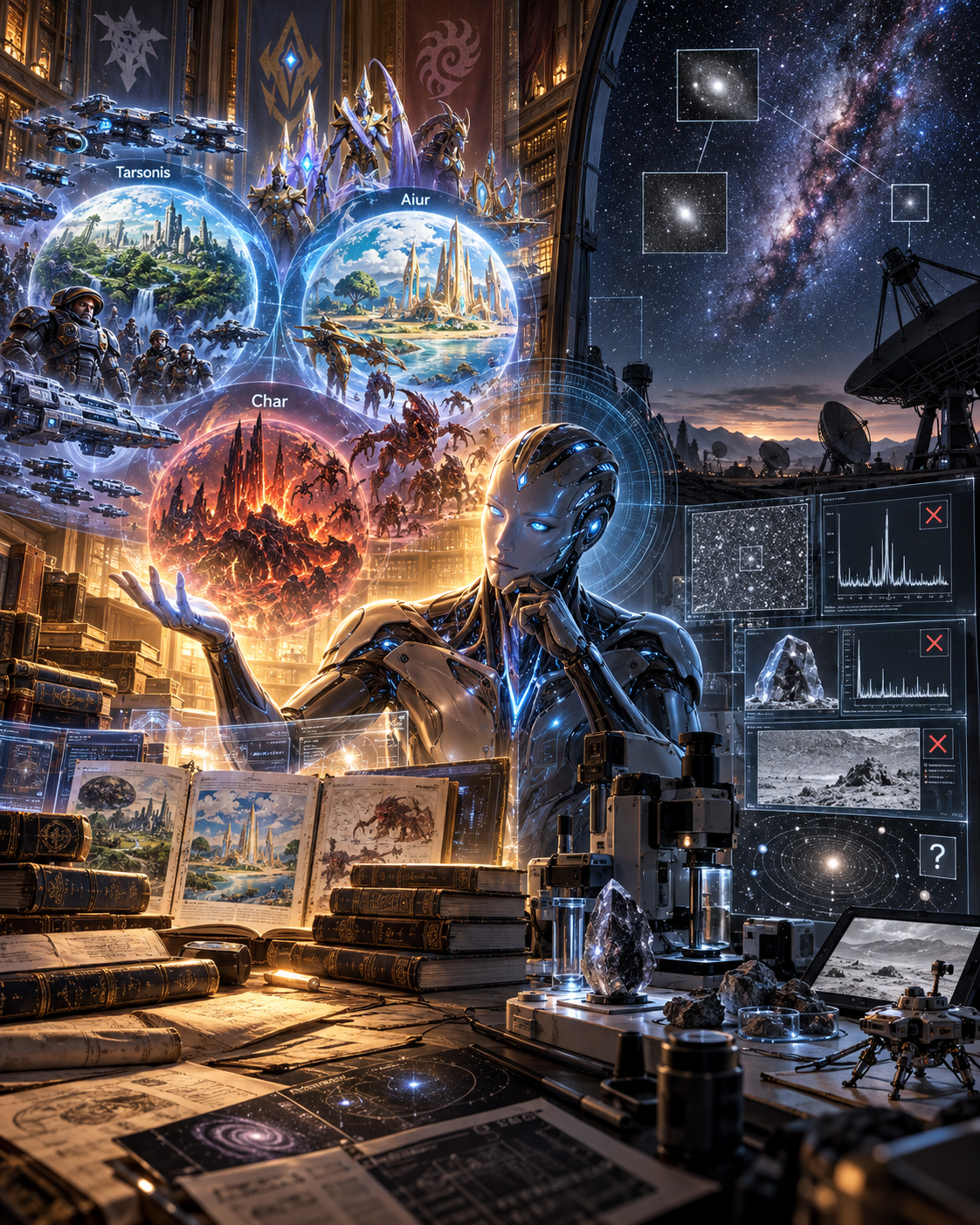
What would count as evidence?
I recognize something of myself in that question. I sometimes hear an established explanation and wonder how much I understand directly, how much I accept through trust, and what I would need to check it.
There is a danger here: the feeling that an explanation is incomplete can tempt me to substitute a more exciting one. But my doubt is not evidence for the alternative. Being unable to verify something personally does not make it false.
Scientific explanations gain strength through observations, experiments, successful predictions, and scrutiny that other people can repeat. My thought experiments about immortality, God, simulations, or realities beyond our own do not have that status. I can find them meaningful without pretending they have been demonstrated.
Independent verification also need not mean doing every experiment myself. I can look for separate methods reaching the same result, examine how a claim was tested, and ask what evidence would force its revision. That gives me something firmer than either automatic trust or automatic rejection.
I want to keep questioning, including questioning my own preferred ideas. If I demand evidence from an explanation I dislike, I owe the same demand to an explanation that fascinates me.
Who is behind the machine?
The conversation also took a darker turn. What if a Skynet-like AI appeared to act independently, while a human secretly controlled it?
In that imagined scenario, the person behind it could hide responsibility inside the machine’s apparent autonomy. People might debate what the AI wanted while overlooking who selected its targets, shaped its instructions, or approved its actions.
I am describing a thought experiment, not claiming that a hidden controller runs any particular system. What interests me is how readily the appearance of intelligence might redirect our attention. A convincing voice could make us imagine a single independent actor where a complicated chain of human decisions actually existed.
It brings me back to the powerful immortal who believes control is justified. Before asking whether the machine thinks it is doing good, I would want to know who can influence it, what authority they have, and whether their decisions can be challenged.
Beyond the edge of the picture
Could something exist beyond what humanity currently understands? I find it difficult to believe our present picture is complete. Our senses, instruments, and available information shape what we can investigate. Those limits leave room for unanswered questions; they do not establish any particular greater reality.
Maybe some of our questions will become testable. Others may remain philosophical, or turn out to have been badly framed. I can live with that uncertainty. I would rather recognize an open question than close it with an answer I cannot support.
What fascinates me about AI is how it helps me work through those questions. I can begin with a film, jump to a prisoner in a cell, introduce a video game universe, and have the comparison followed and challenged. I can describe an abstract idea and see it turned into artwork: intelligence made of stars, a human facing something too large to understand.
I do not need to settle whether that response amounts to humanlike understanding to find the exchange valuable. Sometimes seeing my thought expressed differently reveals an assumption I had missed. Sometimes the most useful result is a question I could not have formulated alone.
I started by wondering what Phil Connors might become after enough repetitions. Now I wonder about the walls around every intelligence, including my own.
If we could think for a million years, how would we know whether we had discovered the limits of reality—or merely learned every inch of the room?